

Federal judge strikes down Trump administration’s rules which sought to restrict H-1B visas for skilled workers. The judge ruled that the interim final rules (IFR) proposed by the U.S. Department of Homeland Security (DHS) and the Department of Labor (DoL) were promulgated in violation of rule making provision of Administrative Procedure Act (APA). The government’s IFRs had proposed restrictive provisions on H-1B visa program especially the wage requirements and eligibility requirements for H-1B visa petitions.
The IFLs had sought to:
- increase the prevailing wage (the wage which has to be offered to H-1B worker or higher) for H-1B by over 40% for certain occupation from current calculation system;
- amend the definition of a “Specialty Occupation” more restrictively;
- amending the criteria for Specialty Occupation positions;
- defining “Worksite” and “Third Party Worksite;
- clarifying the Definition of “United States Employer Replacing “contractor” with “company” in regulatory definition;
- change definition of engaging the Beneficiary to Work to “[engage] the beneficiary to work within the United States, and ha[ve] a bona fide, non-speculative job offer for the beneficiary;
- clarifying the “Employer-Employee Relationship“;
- corroborating Evidence of Work in a Specialty occupation;
- maximum Validity Period for Third-Party Placements to a year at a time;
- revising the Itinerary Requirement for H-1B Petitions;
- apply the itinerary requirement for H-1B petitions as well as petitions filed by agents.
The U.S. District judge Jeffrey White for the Northern District of California ruled that the administration failed to show good cause exists for dispensing with notice and comment as it is generally required as the part of rule-making. Government’s reasoning of “Good cause” to issue Interim Final Rules should be usually invoked in the event of emergencies, where “delay would do real harm to life, property, or public safety.
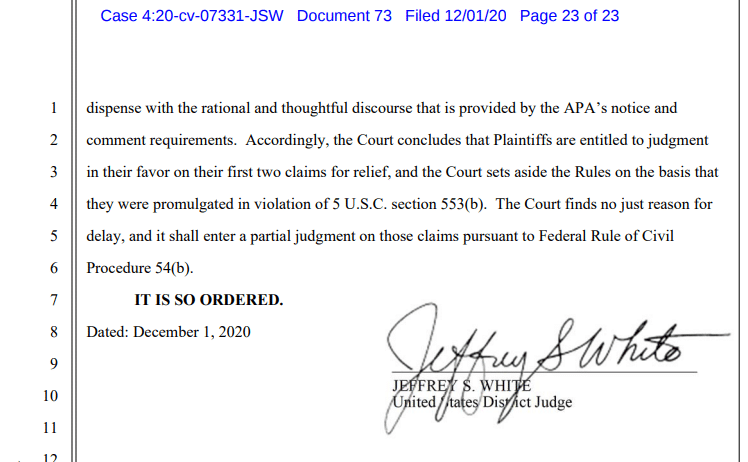
Plaintiffs argued that government unduly delayed in taking action and forfeited the ability to rely on the good cause exception. “Good cause cannot arise as a result of the agency’s own delay.
U.S. Chamber of Commerce and several universities sued the government arguing that there was inadequate time for the public to comment on the new rules and that the salary changes, which would essentially require companies to significantly raise what they pay foreign workers, would force the firing of many employees.
About H-1B visa program
The H-1B visa program allows organizations in the United States to temporarily employ foreign workers in occupations that require the application of a body of highly specialized knowledge and the occupation requires a bachelor’s degree or higher in the specific specialty or its equivalent. H-1B specialty occupations may include fields such as physical sciences, engineering, information technology, medicine, social sciences, business administration, accounting, etc. One may be eligible for an H-1B visa to work for the business or an organization in the United States if the occupation that normally requires a bachelor’s degree or higher in a related field of study (e.g., engineers, scientists or mathematicians, researcher, etc.), and you have at least a bachelor’s degree or equivalent (based on education and/or experience) in a field related to the position.
Frequently asked questions
What did the federal judge rule about the H-1B interim final rules?
The judge ruled that the interim final rules (IFR) proposed by the U.S. Department of Homeland Security (DHS) and the Department of Labor (DoL) were promulgated in violation of the rule making provision of the Administrative Procedure Act (APA). The IFRs had proposed restrictive provisions on the H-1B visa program, especially the wage requirements and eligibility requirements for H-1B petitions.
What did the interim final rules seek to change?
The IFRs sought to increase the prevailing wage for H-1B by over 40% for certain occupations, amend the definition of a “Specialty Occupation” more restrictively, define “Worksite” and “Third Party Worksite,” and clarify the “Employer-Employee Relationship.”
They also sought to limit the maximum validity period for third-party placements to a year at a time and to revise the itinerary requirement for H-1B petitions.
Why did the court reject the government’s use of interim final rules?
U.S. District Judge Jeffrey White of the Northern District of California ruled that the administration failed to show good cause for dispensing with notice and comment, as is generally required as part of rule-making. “Good cause” should usually be invoked in emergencies, where “delay would do real harm to life, property, or public safety.”
Plaintiffs argued that the government unduly delayed in taking action and forfeited the ability to rely on the good cause exception.
Who sued over the rules?
The U.S. Chamber of Commerce and several universities sued the government, arguing that there was inadequate time for the public to comment on the new rules and that the salary changes, which would essentially require companies to significantly raise what they pay foreign workers, would force the firing of many employees.

Represents businesses and individuals on all aspects of U.S. immigration and nationality law, foreign investment and international business transactions.
View profile