

Among Mexicans, desire is high, but about half cite language, cost barriers (original piece appears at http://www.pewresearch.org/about/use-policy/)
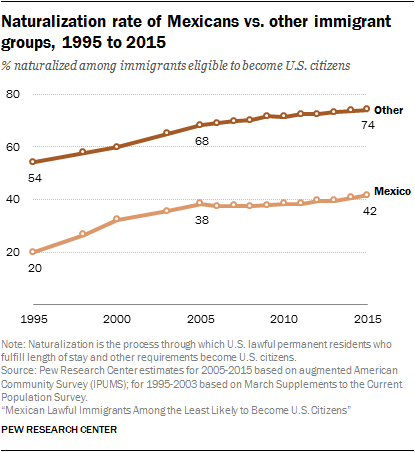 The overall percentage of lawful immigrants to the United States choosing to apply for and gaining citizenship is at its highest level in more than two decades. Yet in terms of naturalization rate, Mexicans – the single largest group of lawful immigrants by country of origin – lag well behind green-card holders eligible to apply from other parts of the globe.
Based on Pew Research Center estimates using the most recent U.S. Census Bureau data available, two-thirds (67%) of lawful immigrants eligible to apply for U.S. citizenship had applied for and obtained citizenship by 2015. This is the highest share since at least the mid-1990s. But among Mexican lawful immigrants eligible to apply, only 42% had applied for and obtained U.S. citizenship by 2015, a rate little changed since 2005 and one of the lowest among all immigrant groups when it comes to country of origin.
 In the United States, the citizenship, or naturalization, rate among all lawful immigrants steadily increased from 1995 to 2005, rising from 47% to 62%. Until about 2005, the naturalization rate among lawful immigrants from Mexico also increased steadily, but did so more rapidly (from 20% in 1995 to 38% in 2005), narrowing the gap between Mexicans and other immigrants. However, between 2005 and 2010, the naturalization rate of Mexican green-card holders leveled off, even as the rate for lawful permanent residents from other parts of the globe continued to rise. Only in the period from 2011 to 2015 did the rate of naturalization among eligible Mexican immigrants significantly increase again at a pace higher than that of other lawful U.S. immigrants – going from 38% to 42% among Mexicans, compared with a 2-percentage-point increase, from 72% to 74% among non-Mexican immigrants.
To become a U.S. citizen, a lawful permanent resident in most cases must:
- Be at least 18 years old.
- Have lived in the U.S. continuously for five years.
- Be able to speak, write, read and understand basic English.
- Answer questions that demonstrate knowledge of U.S. government and history.
- Undergo a successful background check.
- Demonstrate attachment to the principles of the U.S. Constitution.
- Take the oath of citizenship swearing allegiance to the U.S.
Some of those requirements are waived for certain groups:
- Spouses of U.S. citizens can naturalize after three years of continuous residence, if the sponsoring spouse has been a U.S. citizen for all three years.
- Foreign-born minor children become citizens when their parents naturalize.
- Foreign-born minor children who are adopted by U.S. citizens are eligible for citizenship upon their arrival in the U.S.
- Military personnel, their spouses and foreign-born minor children are eligible for expedited and overseas citizenship processing with the possibility of having some of the eligibility requirements diminished or waived. Additionally, in the case of death as result of combat while serving in active duty, citizenship may be granted posthumously to the military member and immediate family members.
The filing fees of processing a citizenship request for all applicants were $680 at the time of the Center’s survey in 2015. This included a $595 filing fee and an $85 biometric services fee for processing fingerprints. Starting Dec. 23, 2016, the citizenship application fee rose by $45.
The filing fee could be waived for applicants with family incomes below 150% of the poverty line, if they, their spouse or head of household receives a means-tested benefit, or if the applicant is experiencing a financial hardship that prevents them from paying the fee (such as unexpected medical bills). Starting Dec. 23, 2016 there is also a reduced filing fee of $320 available for naturalization applicants with family incomes between 150% and 200% the poverty line.
Frequently asked questions
What did Pew Research Center find about naturalization rates among lawful immigrants?
Based on Pew Research Center estimates using the most recent U.S. Census Bureau data available, two-thirds (67%) of lawful immigrants eligible to apply for U.S. citizenship had applied for and obtained citizenship by 2015. This was the highest share since at least the mid-1990s.
How did Mexican lawful immigrants compare?
Among Mexican lawful immigrants eligible to apply, only 42% had applied for and obtained U.S. citizenship by 2015, a rate little changed since 2005 and one of the lowest among all immigrant groups by country of origin. Mexicans are the single largest group of lawful immigrants by country of origin.
Between 2005 and 2010, the naturalization rate of Mexican green-card holders leveled off, even as the rate for lawful permanent residents from other parts of the globe continued to rise. From 2011 to 2015, the rate among eligible Mexican immigrants went from 38% to 42%, compared with an increase from 72% to 74% among non-Mexican immigrants.
What are the general requirements to become a U.S. citizen, according to the article?
To become a U.S. citizen, a lawful permanent resident in most cases must be at least 18 years old; have lived in the U.S. continuously for five years; be able to speak, write, read and understand basic English; answer questions that demonstrate knowledge of U.S. government and history; undergo a successful background check; demonstrate attachment to the principles of the U.S. Constitution; and take the oath of citizenship swearing allegiance to the U.S.
Which groups have some requirements waived?
Spouses of U.S. citizens can naturalize after three years of continuous residence, if the sponsoring spouse has been a U.S. citizen for all three years. Foreign-born minor children become citizens when their parents naturalize, and foreign-born minor children who are adopted by U.S. citizens are eligible for citizenship upon their arrival in the U.S.
Military personnel, their spouses and foreign-born minor children are eligible for expedited and overseas citizenship processing with the possibility of having some of the eligibility requirements diminished or waived.

Represents businesses and individuals on all aspects of U.S. immigration and nationality law, foreign investment and international business transactions.
View profile