

President Trump has issued a Presidential Proclamation on September 19th, 2025 seeking to restrict entry of skilled H-1B workers into the U.S. with a hefty $100,000 H-1B entry fee. While it is still unclear under what authority the government is trying to re-write the H-1B laws and regulations with the President Trump’s Presidential Proclamation on H-1B but from the reading of the Proclamation, Whitehouse’s Factsheets and FAQ, the restrictions appear to apply to specific group to persons as outlined below and for beneficiaries of H-1B’s initial petitions only after September 20th, 2025. The government will likely start enforcing it starting September 21st, 2025.
Section 1 of the Proclamation:
Restriction on Entry. (a) Pursuant to sections 212(f) and 215(a) of the Immigration and Nationality Act (INA), 8 U.S.C. 1182(f) and 1185(a), the entry into the United States of aliens as nonimmigrants to perform services in a specialty occupation under section 101(a)(15)(H)(i)(b) of the INA, 8 U.S.C. 1101(a)(15)(H)(i)(b), is restricted, except for those aliens whose petitions are accompanied or supplemented by a payment of $100,000 — subject to the exceptions set forth in subsection (c) of this section. This restriction shall expire, absent extension, 12 months after the effective date of this proclamation, which shall be 12:01 a.m. eastern daylight time on September 21, 2025. (b) The Secretary of Homeland Security shall restrict decisions on petitions not accompanied by a $100,000 payment for H-1B specialty occupation workers under section 101(a)(15)(H)(i)(b) of the INA, who are currently outside the United States, for 12 months following the effective date of this proclamation as set forth in subsection (a) of this section. The Secretary of State shall also issue guidance, as necessary and to the extent permitted by law, to prevent misuse of B visas by alien beneficiaries of approved H-1B petitions that have an employment start date beginning prior to October 1, 2026. (c) The restriction imposed pursuant to subsections (a) and (b) of this section shall not apply to any individual alien, all aliens working for a company, or all aliens working in an industry, if the Secretary of Homeland Security determines, in the Secretary’s discretion, that the hiring of such aliens to be employed as H-1B specialty occupation workers is in the national interest and does not pose a threat to the security or welfare of the United States.
The government has clarified that the Proclamation does not:
- Does not apply to any previously issued H-1B visas, or any petitions submitted prior to 12:01 a.m. eastern daylight time on September 21, 2025.
- Does not change any payments or fees required to be submitted in connection with any H-1B renewals. The fee is a one-time fee on submission of a new H-1B petition.
- Does not prevent any holder of a current H-1B visa from traveling in and out of the United States.
Government official had clarified that the Proclamation also does not apply to doctors seeking to work in the U.S. on H-1B but it is unclear if H-1Bs for Registered Nurses, Physical Therapists and other related healthcare professionals exempted.
Government officials had made communications that a new H-1B extension, transfer or amendment would also be exempted from this Proclamation.
From the immigration law and reading of the Presidential Proclamation, the order appear to apply only for those who are “outside the U.S.” and therefore a new H-1B visa application or their entries into the U.S. will be affected from this Proclamation. But it is unclear how the government will treat one who is in the U.S. when filing a H-1B petiton after September 20th, 2025 but later travels abroad and seeks a new H-1B visa or seeks an entry into the U.S. on an H-1B status.
The Executive Action will surely face a legal challenge and the Courts will have a final say about its validity.
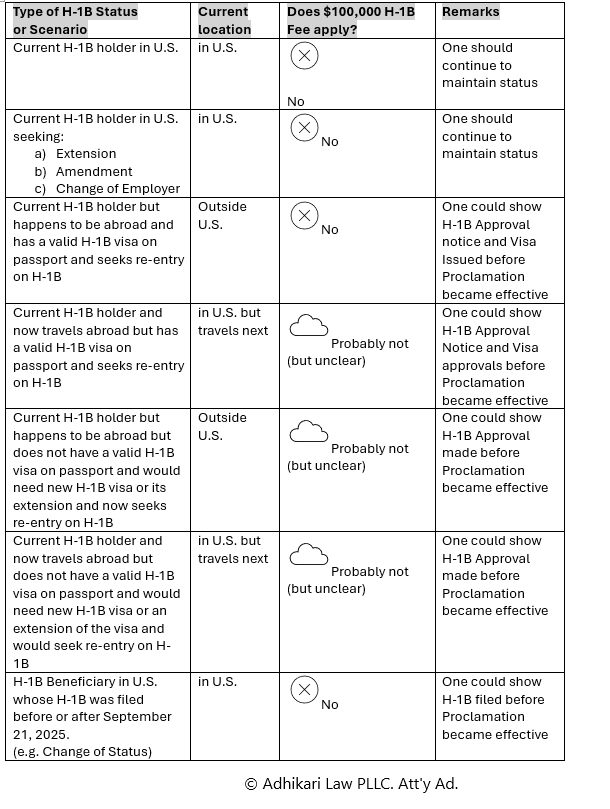

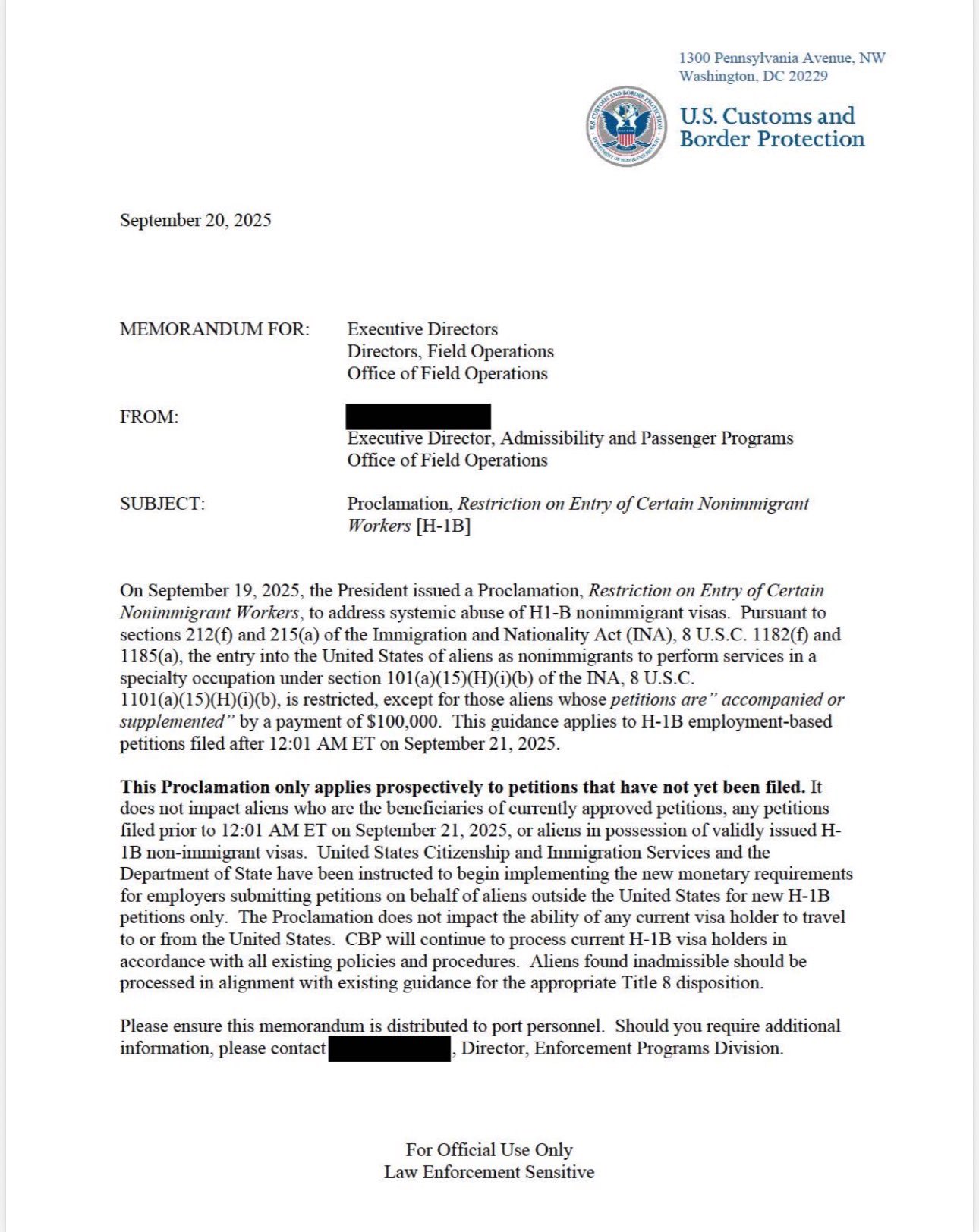
U.S. Customs and Border Protection (CBP) provides following updates. Similarly, USCIS provides the following updates. From this, existing H-1B holders or one who had H-1B filed before September 21st, 2025 are not affected from new Proclamation. It is unclear about the future re-entry by H-1B workers who had H-1B filed before Sep 21st, 2025 or had extension filed or obtained in the U.S. after September 21st, 2025.
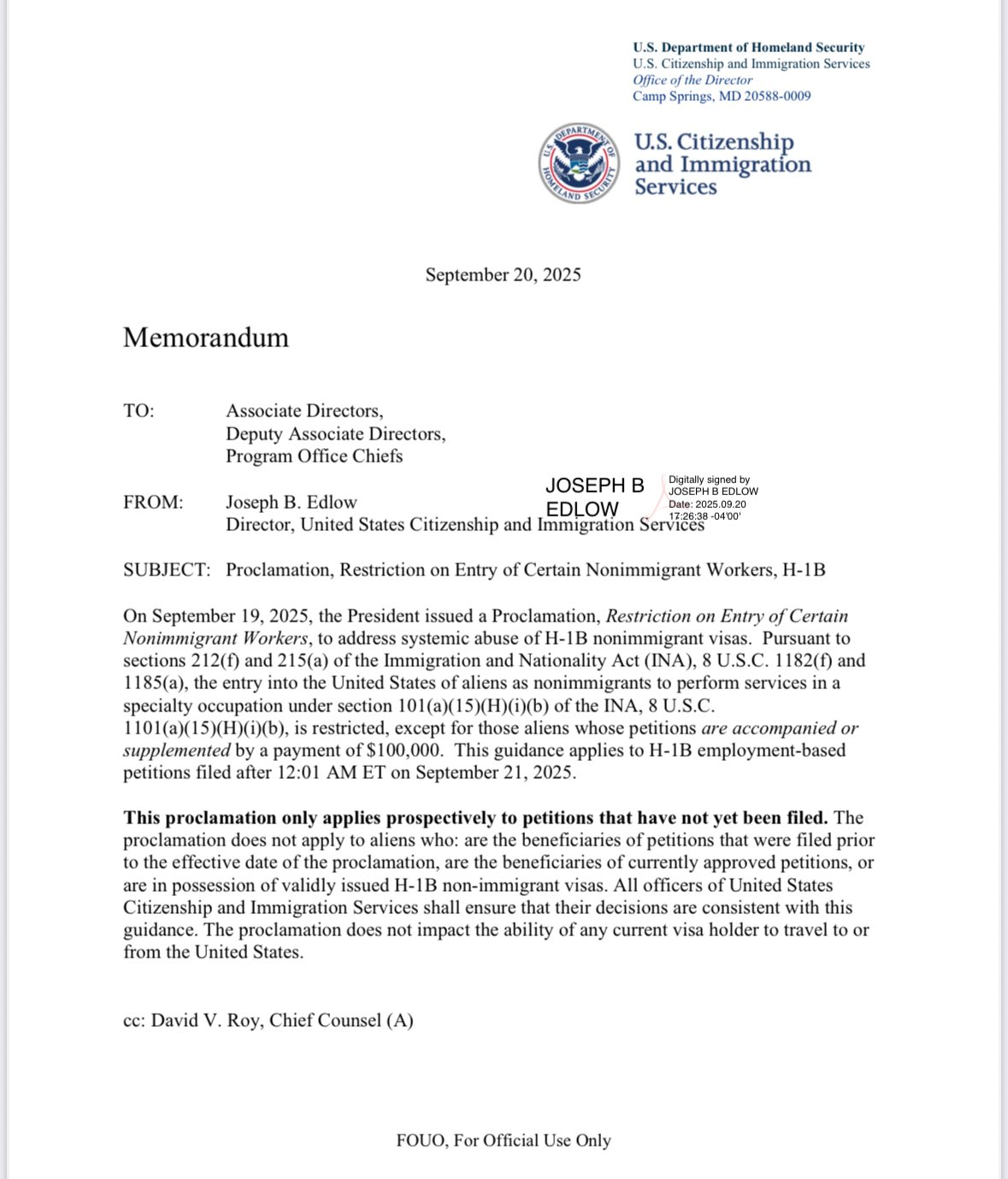
Similarly, USCIS provides the following updates. From this, existing H-1B holders or one who had H-1B filed before September 21st, 2025 are not affected from new Proclamation. It is unclear about the future re-entry by H-1B workers who had H-1B filed before Sep 21st, 2025 or had extension filed or obtained in the U.S. after September 21st, 2025.
The U.S. Department of State in turn has provided its own update. It states, the Proclamation does not:
- Apply to any previously issued H-1B visas, or any petitions submitted prior to 12:01 a.m. eastern daylight time on September 21, 2025.
- Does not change any payments or fees required to be submitted in connection with any H-1B renewals. The fee is a one-time fee on submission of a new H-1B petition.
- Does not prevent any holder of a current H-1B visa from traveling in and out of the United States.
State Department states that the government will be taking further steps to reform the H-1B program, as contemplated in the Proclamation, including:
- A rulemaking by the Department of Labor to revise and raise the prevailing wage levels in order to upskill the H-1B program and ensure that it is used to hire only the best of the best temporary foreign workers.
- A rulemaking by the Department of Homeland Security to prioritize high-skilled, high-paid aliens in the H-1B lottery over those at lower wage levels.
Below is the legal background of the Proclamation and what authority the President was citing in issuing this Proclamation.
Section 212(f) of INA [8 U.S. Code § 1182(f)] states:
(f) Suspension of entry or imposition of restrictions by President:
Whenever the President finds that the entry of any aliens or of any class of aliens into the United States would be detrimental to the interests of the United States, he may by proclamation, and for such period as he shall deem necessary, suspend the entry of all aliens or any class of aliens as immigrants or nonimmigrants, or impose on the entry of aliens any restrictions he may deem to be appropriate. Whenever the Attorney General finds that a commercial airline has failed to comply with regulations of the Attorney General relating to requirements of airlines for the detection of fraudulent documents used by passengers traveling to the United States (including the training of personnel in such detection), the Attorney General may suspend the entry of some or all aliens transported to the United States by such airline.
Similarly, the Section 215 (a) of INA [8 U.S. Code § 1185] provides:
(a): Restrictions and prohibitions
Unless otherwise ordered by the President, it shall be unlawful—
(1) for any alien to depart from or enter or attempt to depart from or enter the United States except under such reasonable rules, regulations, and orders, and subject to such limitations and exceptions as the President may prescribe;
(2) for any person to transport or attempt to transport from or into the United States another person with knowledge or reasonable cause to believe that the departure or entry of such other person is forbidden by this section;
(3) for any person knowingly to make any false statement in an application for permission to depart from or enter the United States with intent to induce or secure the granting of such permission either for himself or for another;
(4) for any person knowingly to furnish or attempt to furnish or assist in furnishing to another a permit or evidence of permission to depart or enter not issued and designed for such other person’s use;
(5) for any person knowingly to use or attempt to use any permit or evidence of permission to depart or enter not issued and designed for his use;
(6) for any person to forge, counterfeit, mutilate, or alter, or cause or procure to be forged, counterfeited, mutilated, or altered, any permit or evidence of permission to depart from or enter the United States;
(7) for any person knowingly to use or attempt to use or furnish to another for use any false, forged, counterfeited, mutilated, or altered permit, or evidence of permission, or any permit or evidence of permission which, though originally valid, has become or been made void or invalid.(b) Citizens
Except as otherwise provided by the President and subject to such limitations and exceptions as the President may authorize and prescribe, it shall be unlawful for any citizen of the United States to depart from or enter, or attempt to depart from or enter, the United States unless he bears a valid United States passport.
(c) Definitions
The term “United States” as used in this section includes the Canal Zone, and all territory and waters, continental or insular, subject to the jurisdiction of the United States. The term “person” as used in this section shall be deemed to mean any individual, partnership, association, company, or other incorporated body of individuals, or corporation, or body politic.
(d) Nonadmission of certain aliens
Nothing in this section shall be construed to entitle an alien to whom a permit to enter the United States has been issued to enter the United States, if, upon arrival in the United States, he is found to be inadmissible under any of the provisions of this chapter, or any other law, relative to the entry of aliens into the United States.
(e) Revocation of proclamation as affecting penalties
The revocation of any rule, regulation, or order issued in pursuance of this section shall not prevent prosecution for any offense committed, or the imposition of any penalties or forfeitures, liability for which was incurred under this section prior to the revocation of such rule, regulation, or order.
(f) Permits to enter
Passports, visas, reentry permits, and other documents required for entry under this chapter may be considered as permits to enter for the purposes of this section.
(last updated September 22, 2025, more updates forthcoming).
Frequently asked questions
What did the September 19, 2025 H-1B proclamation do?
President Trump issued a Presidential Proclamation on September 19th, 2025 seeking to restrict entry of skilled H-1B workers into the U.S. with a $100,000 H-1B entry fee. Entry as H-1B nonimmigrants is restricted, except for those whose petitions are accompanied or supplemented by a payment of $100,000. The restriction shall expire, absent extension, 12 months after the effective date of 12:01 a.m. eastern daylight time on September 21, 2025.
Who does the proclamation not apply to, according to the government’s clarifications?
The government clarified that the Proclamation does not apply to any previously issued H-1B visas, or any petitions submitted prior to 12:01 a.m. eastern daylight time on September 21, 2025. It does not change any payments or fees for H-1B renewals; the fee is a one-time fee on submission of a new H-1B petition. It does not prevent any holder of a current H-1B visa from traveling in and out of the United States.
Can the $100,000 requirement be waived?
The restriction shall not apply to any individual alien, all aliens working for a company, or all aliens working in an industry, if the Secretary of Homeland Security determines, in the Secretary’s discretion, that the hiring of such aliens as H-1B workers is in the national interest and does not pose a threat to the security or welfare of the United States.
What did the article say was still unclear?
The article says it was unclear under what authority the government is trying to re-write the H-1B laws, and unclear how the government will treat one who is in the U.S. when filing an H-1B petition after September 20th, 2025 but later travels abroad and seeks a new H-1B visa or entry. It also says it is unclear whether H-1Bs for Registered Nurses, Physical Therapists and other related healthcare professionals are exempted, although doctors were said to be exempt.
What further H-1B reforms did the State Department say were planned?
The State Department states that the government will take further steps, including a rulemaking by the Department of Labor to revise and raise the prevailing wage levels, and a rulemaking by the Department of Homeland Security to prioritize high-skilled, high-paid aliens in the H-1B lottery over those at lower wage levels.

Represents businesses and individuals on all aspects of U.S. immigration and nationality law, foreign investment and international business transactions.
View profile