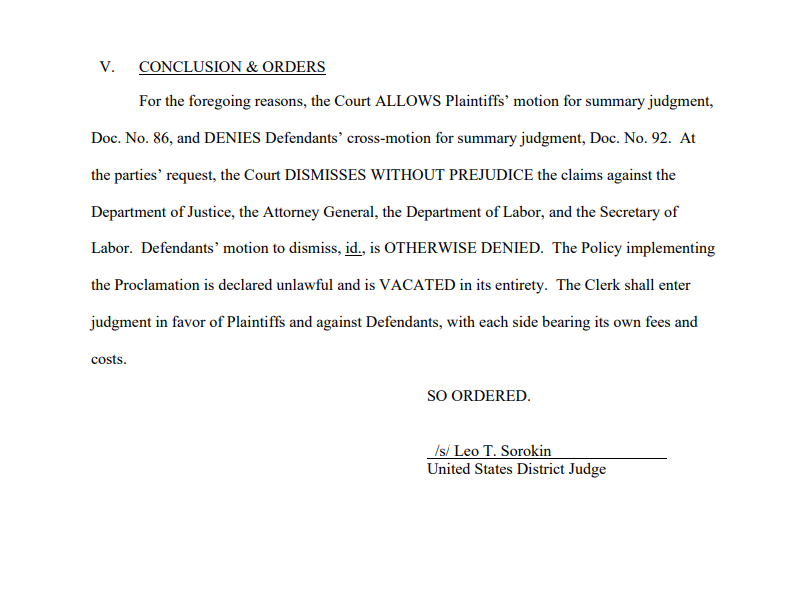
Adhikari Law PLLC. U.S. District Court in Massachusetts has found the President Trump’s H-1B Proclamation imposing $100,000 as unlawful and vacated it entirely. Now the USCIS would have to resume processing H-1B petitions with consular processing of the visa without requiring a payment of $100,000 additional fee. UPDATE However, the judge has paused the effectiveness of his order until the U.S. Court of Appeals for the First Circuit weighs in. Therefore, the additional H-1B tax fee is not fully terminated as of yet.
Judge Leo T. Sorokin had ordered that the President’s H-1B Proclamation violates Administrative Procedure Act (“APA”) and the U.S. Constitution. The court finds that the policy is arbitrary and capricious and allows Plaintiffs’ motion for summary judgment.
Key Takeaway Points about the judge’s Decision and H-1B Proclamation
- A U.S. federal judge in Massachusetts vacated President Donald Trump’s H-1B policy proclamation imposing a $100,000 fee for employers’ H-1B visa applications.
- The Court finds that the policy violated the federal Administrative Procedure Act and the Constitution.
- The judge stated that the payment is a tax that U.S. Congress had not delegated to the President.
- The Trump administration may appeal the decision.
About H-1B work visa program of USA
The H-1B program allows companies in the United States to temporarily employ foreign workers in occupations that require the application of a body of highly specialized knowledge and a bachelor’s degree or higher in the specific specialty, or its equivalent. H-1B specialty occupations may include fields such as physical sciences, engineering, information technology, medicine, social sciences, business administration, accounting, etc. You may be eligible for an H-1B visa to work for the business or an organization in the United States if the occupation that normally requires a bachelor’s degree or higher in a related field of study (e.g., engineers, scientists or mathematicians, researcher, etc.), and you have at least a bachelor’s degree or equivalent (based on education and/or experience) in a field related to the position.
Initial period of stay in the United States: Up to 3 years. Extensions are possible in up to 3 year increments. Maximum period of stay generally 6 years (extensions beyond 6 years may be possible).
Could an H-1B Visa work for you? Ask yourself the following questions to see if you might qualify:
- Do you have a bachelor’s degree or the equivalent (based on relevant experience)?
- Will you be working in a “specialty occupation?”
- Will you be earning a wage?
If you answered yes to most of the questions above, then you may likely qualify for an H-1B Visa.
The H-1B visa has an annual numerical limit, or cap, of 65,000 visas (5000 out of these are allocated to professionals from Chile and Singapore) each fiscal year. The first 20,000 petitions filed on behalf of beneficiaries with a U.S. master’s degree or higher are exempt from the cap. Additionally, H-1B workers who are petitioned for or employed at an institution of higher education (or its affiliated or related nonprofit entities), a nonprofit research organization, or a government research organization are not subject to this numerical cap (Cap Exempt). Cap numbers are often used up very quickly, so it is important to plan in advance if you will be filing for an H-1B visa that is subject to the annual H-1B numerical cap. The U.S. government’s fiscal year starts on Oct. 1. H-1B petitions can be filed up to 6 months before the start date, which is generally April 1 for an October 1 start date.
(last updated June 8, 2025, more updates forthcoming).
Note: This is a blog post by Adhikari Law PLLC and should NOT be construed as a legal advice. Changes in immigration policies and procedures are complex and may require a consultation with an experienced immigration lawyer.
You can contact us at (+1) 202 600 7742, or email us at info@adhikarilaw.com if you will have any question on this topic. You can also reach us to learn about our legal services or complete the Form to request an Attorney Consultation.
